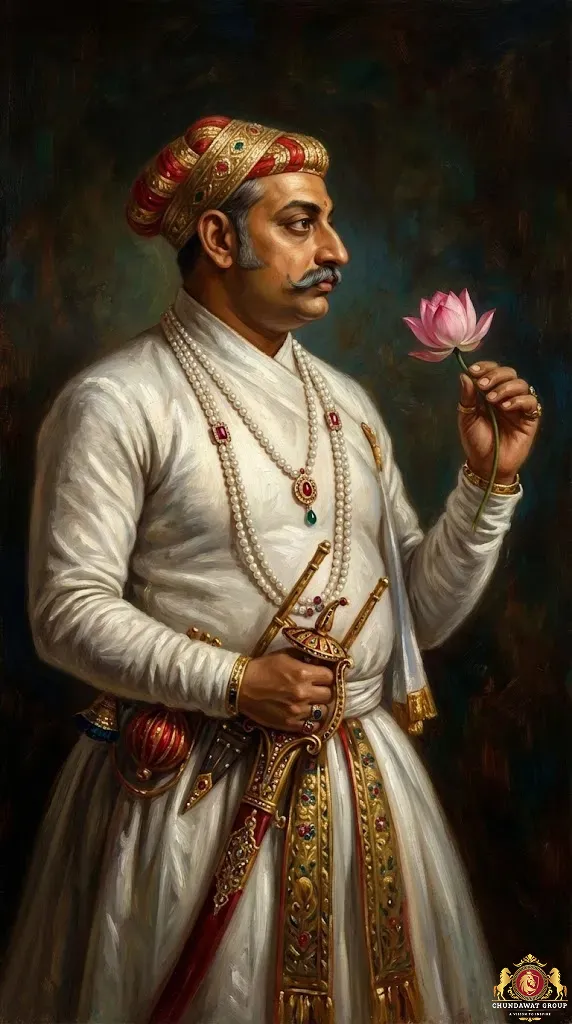
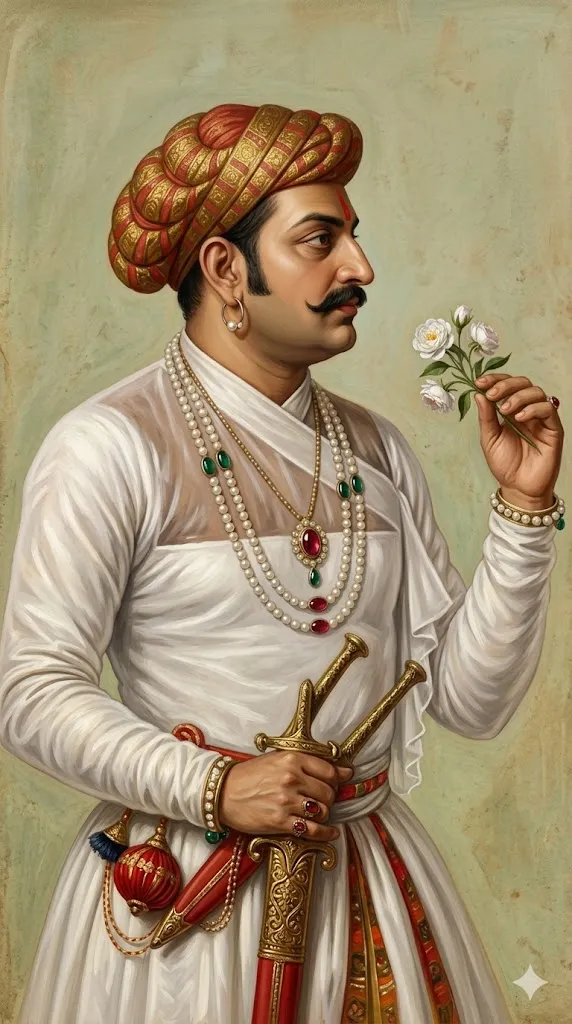
Who Was Maharana Jagat Singh I?
Maharana Jagat Singh I (1607–1652) was the Maharana of Mewar from 1628 to 1652. A member of the Sisodia dynasty, he inherited a kingdom that had entered a more stable phase after Mewar's long conflict with the Mughal Empire.
His reign is particularly remembered for the flourishing of architecture, temple building, literature and Mewari miniature painting. The completion of Jag Mandir on Lake Pichola and the construction of the magnificent Jagdish Temple in 1651 are among the most visible reminders of his patronage.
Jagat Singh's 24-year reign represents an important transition in Mewar's history: from a kingdom dominated by prolonged military resistance to one increasingly known for its cultural production and architectural achievements.
Family and Early Life
Jagat Singh was born in 1607 into the Sisodia ruling family of Mewar. His father, Maharana Karan Singh II, succeeded Amar Singh I in 1620.
When Prince Khurram rebelled against his father Emperor Jahangir, he sought refuge in Mewar. Karan Singh provided him protection, and the prince and his family were sheltered at Udaipur—a pavilion associated with this episode survives within the complex of Jag Mandir and is commonly known as Gul Mahal or Khurram's Palace.
This connection became significant when Khurram became Emperor Shah Jahan in 1628—the same year in which Jagat Singh succeeded his father.
His Accession to the Throne
Maharana Jagat Singh I succeeded his father Karan Singh II in 1628. He came to the throne at a particularly interesting moment in Mewar's history. The long period of military confrontation with the Mughals had been brought to an end by his grandfather Amar Singh I's treaty in 1615. His father Karan Singh II had then sheltered the Mughal prince Khurram.
When Jagat Singh became Maharana, Shah Jahan—the same prince his father had sheltered—was the new Mughal emperor. This gave the Mewar–Mughal relationship a personal dimension that influenced the political dynamics of Jagat Singh's reign.
Mewar Under Jagat Singh I
Jagat Singh's reign was characterised by relative stability compared to the warfare that had dominated Mewar during the reigns of Maharana Pratap and Amar Singh I. The 1615 treaty had established a political framework for coexistence between Mewar and the Mughal Empire.
However, this did not mean Jagat Singh's reign was without political challenges. He pursued an assertive policy toward neighbouring Rajput states and attempted to recover or strengthen Mewar's influence over areas including Dungarpur, Sirohi, Banswara, and Devaliya-Pratapgarh.
While Jagat Singh accepted Mughal suzerainty, he generally avoided allowing regional disputes to develop into major war with the Mughal Empire.
Jag Mandir
Jag Mandir is an island palace complex on Lake Pichola in Udaipur and one of the most important architectural projects associated with Maharana Jagat Singh I. The development of Jag Mandir was a multi-generational project—earlier work was undertaken by Maharana Amar Singh I and Karan Singh II, while Jagat Singh completed and significantly developed the complex.
The island palace features distinctive yellow sandstone construction, elephant sculptures, garden courtyards, and the Gul Mahal pavilion associated with Prince Khurram's stay. The complex served as a royal retreat, a pleasure garden, and a symbol of Mewar's artistic and architectural ambition.
Jag Mandir remains one of the most recognisable landmarks of Udaipur and is widely regarded as one of the finest examples of Rajput island palace architecture.
Jagdish Temple
The Jagdish Temple, completed in 1651, is perhaps the single most important architectural achievement of Maharana Jagat Singh I's reign. The temple was originally associated with the name Jagannath Rai, and the principal deity is Vishnu.
The temple represents one of the most prominent examples of seventeenth-century temple architecture in Udaipur and the broader Mewar region. It features elaborate stone carvings, a towering shikhara (spire), sculptural programmes depicting scenes from Hindu mythology, and detailed architectural ornamentation.
Located in the heart of the old city of Udaipur, Jagdish Temple remains one of the city's most important religious and architectural landmarks.
Mewari Miniature Painting
Maharana Jagat Singh I's court was one of the most important centres for the development of the Mewar school of miniature painting. His patronage supported artists including Sahibdin and Manohar, whose work helped establish one of the great periods of Indian miniature art.
Important illustrated works from this period include Ragamala, Rasikapriya, Gita Govinda, Bhagavata Purana, Ramayana, and genealogical and religious manuscripts. These paintings combined Hindu religious and literary themes, strong colours, stylised architecture, landscape settings and distinctive Mewari figures.
The Mewar school under Jagat Singh I is often regarded as having reached its golden period. Artists are believed to have used a single hair from a squirrel to execute the detailed work of these exquisite paintings.
Relationship With the Mughal Empire
Jagat Singh's relationship with the Mughal Empire was shaped by the 1615 treaty and by the personal connection between the Mewar royal family and Shah Jahan. Although Mewar had accepted Mughal suzerainty, the relationship was not one of simple subordination.
The personal connection dating from Prince Khurram's refuge at Udaipur gave the relationship a particular character. However, tensions did arise, particularly regarding Mewar's regional policies. In 1643, negotiations involving Jagat Singh's son Raj Singh helped address tensions between Mewar and the Mughal court.
Perhaps the most interesting aspect of Jagat Singh's reign is the way Mewar interacted with the Mughal Empire culturally—Mewari artists could absorb elements of Mughal artistic practice while retaining a recognisably Mewari visual language.
Major Architectural Works
Beyond Jag Mandir and Jagdish Temple, Jagat Singh I's reign saw continued development of the Udaipur City Palace complex and other architectural projects. He continued the tradition of royal patronage that had been growing since the establishment of Udaipur as the capital of Mewar.
The City Palace additions during his reign contributed to the sprawling complex that visitors see today. He also supported religious architecture and patronised the construction and maintenance of temples and religious institutions across Mewar.
Modern Udaipur's identity is inseparable from the monuments, artistic traditions and lake architecture that developed during the seventeenth century, and Jagat Singh was one of the rulers who helped transform Udaipur from a relatively young capital into a major centre of Rajput architecture, religion and art.
Death and Succession
Maharana Jagat Singh I died on 10 April 1652 in Udaipur after a reign of 24 years. He was succeeded by his son Maharana Raj Singh I.
Raj Singh I inherited a kingdom that was culturally and architecturally richer than the one Jagat Singh had received. However, Raj Singh would face new political challenges, including the increasingly assertive religious policies of the later Mughal Emperor Aurangzeb.
Jagat Singh I's Legacy
Maharana Jagat Singh I's legacy rests on three interconnected achievements: political pragmatism, architectural patronage and cultural flourishing.
He preserved the political settlement with the Mughals while still attempting to strengthen Mewar's influence in neighbouring regions. Jag Mandir and Jagdish Temple remain powerful physical reminders of his reign—Jag Mandir represents the royal and secular world of the lake palace, while Jagdish Temple represents the religious and ceremonial culture of the Mewar court.
His court supported artists such as Sahibdin and Manohar, whose manuscripts are among the masterpieces of the Mewar school. His reign is often regarded as the golden period of the Mewar school of painting, and his architectural works helped define the visual identity of Udaipur that continues to attract visitors and scholars today.
📜 Did You Know?
Jag Mandir was developed over multiple reigns—earlier work was undertaken by Maharana Amar Singh I and Karan Singh II, while Jagat Singh completed and significantly developed the complex.
Jagdish Temple, completed in 1651, was originally associated with the name Jagannath Rai. The principal deity is Vishnu, and the temple remains one of the most prominent examples of seventeenth-century temple architecture in Udaipur.
The artist Sahibdin produced important illustrated manuscripts including Ragamala, Gita Govinda, Bhagavata Purana and parts of the Ramayana during Jagat Singh's reign.
Shah Jahan already had a personal connection with the Mewar royal family from his years as Prince Khurram, when he was sheltered at Jag Mandir.
In 1643, negotiations involving Jagat Singh's son Raj Singh helped address tensions between Mewar and the Mughal court.
Under his patronage, the Rajput school of miniature painting reached its zenith—artists are believed to have used a single hair from a squirrel to execute the detailed work of these exquisite paintings.
Frequently Asked Questions
Who was Maharana Jagat Singh I?
+
Maharana Jagat Singh I was the Maharana of Mewar from 1628 to 1652. He is remembered as one of the greatest patrons of architecture and art in Mewar history.
When did Maharana Jagat Singh I rule?
+
He ruled from 1628 to 1652—a period of 24 years.
What did Maharana Jagat Singh I build?
+
His most famous construction projects were the completion of Jag Mandir on Lake Pichola and the Jagdish Temple in Udaipur, completed in 1651.
What is Jag Mandir?
+
Jag Mandir is an island palace complex on Lake Pichola in Udaipur. It was developed over multiple reigns but significantly completed by Jagat Singh I.
What is Jagdish Temple?
+
Jagdish Temple is a Hindu temple dedicated to Vishnu, completed in 1651 during Jagat Singh I's reign. It remains one of the most important architectural landmarks in Udaipur.
What was the Mewar school of miniature painting?
+
The Mewar school was a tradition of Indian miniature painting that flourished under Jagat Singh I's patronage, with artists like Sahibdin creating masterpieces including Ragamala and Bhagavata Purana manuscripts.
Who was Sahibdin?
+
Sahibdin was one of the most important artists of the Mewar school of miniature painting. He was active during Jagat Singh I's reign and produced illustrated manuscripts including Ragamala, Gita Govinda and Bhagavata Purana.
What was Jagat Singh I's relationship with Shah Jahan?
+
Shah Jahan had a personal connection with the Mewar royal family from his years as Prince Khurram, when he was sheltered at Jag Mandir during his rebellion against Jahangir.
Who succeeded Maharana Jagat Singh I?
+
His son Maharana Raj Singh I succeeded him in 1652.
When did Maharana Jagat Singh I die?
+
He died on 10 April 1652 in Udaipur.
Why is Jagat Singh I called the greatest builder of Mewar?
+
His reign saw the completion of Jag Mandir, the construction of Jagdish Temple, additions to the City Palace, and the flourishing of Mewari miniature painting—making it the golden age of Mewar's architectural and cultural achievement.